Thursday, 18 January 2024

A memorable trip to Amritsar & Hills, Travelogue - Part 1

Nestled far up in the northwestern corner of Punjab, Amritsar is easier to reach than what you might imagine; with this thought we began our recent trip to Amritsar, Dharamshala & Dalhousie in December to enjoy a long awaited vacation. I have always been a history buff and particularly about our country so naturally a trip to Amritsar was always on the cards because of many historical places and the nearby border with Pakistan, popularly known as 'Wagah Border' although Wagah is a place in Pakistan, the Indian side of the border is at an area called 'Attari'.

We had planned quite extensively and had the itinerary ready, so here is the story of the trip:

DAY 1

  • We had landed up in Amritsar at 11 in the morning via a flight from Ahmedabad. We then proceeded to check into a hotel near the Market area adjacent to Partition Museum. The atmosphere was great and it took some time for us to soak in everything. The city is filled with delicious smells of chole Kulche, bazaars, tea-stalls, kulfis and fresh lassi. You will also find cycle rickshaws plying around in narrow old city streets and some friendly locals.

    Coming back to the Partition Museum, it is very well put together with a lot of anecdotes from the people who had gone through the pain, it was the largest migration in human history. The museum documents the catastrophic loss of life and livelihood through testimonials of the partition survivors.


  • After Partition Museum, we had made our way to Attari/Wagah border, it is located some 22 to 30 kms from Amritsar market, with scenic views on either side. There is a stadium constructed at the border where people can sit and watch the ceremonies being conducted by the BSF. 
    If you had been a nationalist, this spot will heighten that emotion further. The 110 meter long Indian flagpole happens to be the highest flagpole in the country.

    The flag retreat ceremony is a treat to watch and the atmosphere is filled with patriotism. The ceremony involves elaborate drills, synchronized marching and the lowering of both countries' flags and a show of mutual respect. The event is a public spectacle drawing tourists from all over the world. I would recommend everyone a visit at least once here to witness this. The feeling is literally something else.
    There is also a BSF museum detailing the history of BSF along with its achievements.
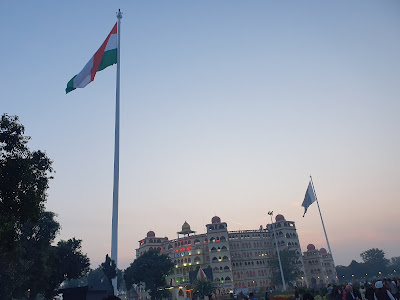


    The 110 meter Indian flagpole


  • We had a night walk around the Golden Temple complex and it was beautiful to see the temple with all the lights. The place is huge and you can see people milling around, volunteering and helping others. It was an unforgettable experience. The market around temple complex is quite unique and you would not be blamed if you go for shopping or having lassi, we had ended our Day 1 with some amazing memories. It's a city of pilgrimages.


DAY 2

  • Day 2 began early as we went in for a morning walk to the market near the Partition Museum and walked all the way till Golden Temple. Its a shoppers' delight, you can easily get good quality clothes/footwear with reasonable prices all around in the market. The air is usually quite fresh.

  • We had our breakfast at the hotel where we had stayed and quality of the food was good, in fact that's what we had observed in our trip; you may leave here with few kilos added to your weight. Ghee is a staple in Punjabi cooking and the local butter is found in hot naans, dals, curries and rotis. 'Kesar Da Dhaba' & 'Brothers' Da Dhaba' are two must visit Dhabas in Amritsar according to me.
     
  • Our next stop was the Jallianwala Bagh, the place where I was filled with sadness. It's a place which reminds us of the cruelty of General Dyer and his men who had shot down innocent people. It has walls ridden with bullet holes and memorial plaques displaying the happenings of the dreaded massacre. The garden is maintained impeccably with galleries providing the information about the history. The true account of Jallianwala Bagh brutality is too hard for me to describe here hence just focusing on the tourist side of the story. 

    Things to see in the Jallianwala Bagh Compound

    - A section of the wall that still bears the bullet marks.
    - The Martyr's well, the well into which people had jumped on that day to escape bullet shots.
    - A semi-circular section that presents the place from where British soldiers had fired at the people.
    - Flame of Liberty, the memorial built in memory of martyrs
    - The martyrs galleries with audio visual notes. 

  • With a tinge of sadness, we left Jallianwala Bagh and went back to our hotel and proceeded towards Dharmshala during the day. That will be covered in the Part II of this travelogue. Some pictures of Jallianwala Bagh.


Saturday, 11 November 2023

Good Bye to Good Old Trusted Companion!

Saying goodbye is never easy in life, be it for a person or a thing which you loved dearly. It's always a sinking feeling but deep down you know nothing lasts forever. There's an expiry date to almost everything in life and no one can escape it.

With this in mind, I have had two such incidents in the last two months which have made me realize once again that we cannot hold on to people or things in life.

I have written excessively on my good old trusted companion- my car on various platforms. Here are the links of two of my blogs :

https://pratikmantri.blogspot.com/2021/11/15-years-of-good-old-trusted-companion.html 

https://pratikmantri.blogspot.com/2018/02/my-leave-worries-behind-car.html


It has been a wonderful journey and I have already written on how peaceful it was driving that good old car and so much more but as happens to all of us, the car started showing its age of 17 plus years but was majorly trouble free apart from few niggles here and there. It was unanimously agreed by everyone in the family to upgrade to a better car and I couldn't convince my family to keep it for the sake of nostalgia and positive vibes. If it had been my call, I would personally never sell it; would keep it forever only because I know life is hard and few things which give you happiness should be preserved. There's obviously a pragmatic and more mind-over-heart view that old cars are not worth keeping, given the rising running costs.

Anyways, so that's done now. It will go most probably this month end and a part of me will miss the sound of that amazing and powerful engine (it could pull on steep incline even with 5 on board), comfortable seats, spacious cabin and loads of memories.

Moving on, I have had the pleasure of working with my mentor of last 7 years for last 6 months. He had been posted to the higher office where our office reported to and I got the opportunity to work with him for last 6 months. He had attained superannuation (retirement in common parlance) at the end of September 2023. I knew he was going and kept on counting on days in reverse but post his absence, it struck me how life at office was so different.
My office colleagues and myself included would agree that he was a pillar in our department and trained all of us to become independent with sheer hard work and constant learning. He worked tirelessly for years and made the company stronger by going out of his way to mentor young officers like me.

I am now in his shoes and I hope to replicate what he did! Thank you sir, I will forever be grateful for your support, training and for always listening to my stories. 


Saying Good-Bye is difficult always!

Thursday, 2 June 2022

Remembering KK, his soulful voice and my childhood memories!

On the night of May 31, the news about the sad demise of KK came out, it left everyone shocked and sad. I wish it was just a bad dream but as more details emerged, it was truly heartbreaking to accept. It was too early, he was just 53 and was as good as before. As it happens with life most of the times, we realise the value of a person/something when it is not with us, I had started to look back.

You had given us the best time of our childhood to us 90s kids. Your voice was sort of coming of age for many of us. We sang your songs at farewells, with friends, family and weddings too. You were everywhere and rightly so - Phone FM, Walkman, CD Players, Music Systems at home, Computer Speakers, Musical events, School Bus/Auto, Car FM and in our minds. It was very easy to remember the lyrics of the songs because of your melodious and soulful voice. You were the ultimate rockstar for us back then, now and forever. For me, your voice is the voice of love. I still have a lot of your songs in playlists everywhere.

It was a dream come true when I had attended your live concert in Ahmedabad back in those days of pre 2010 era. I remember the aura, fan-dom, the love which youngsters and teens had in those days for you and you had never disappointed your fans. 

Your songs made all of us now in our late 20s/early 30s, turn back to childhood and relive some memory bookmarks to our life. Every important memory of my life has a KK song attached for that background music. That feeling of nostalgia. That feeling of being wanting to go back to those days. Those beautiful memories of school and college. Your song had become the official farewell song in schools and colleges. You were part of everyone's farewell. That fuzzy feeling. Come back sir for once! 

A big part of my youth was shaped by your melodious songs. I still listen to your songs whenever I hit a bad patch in life and feel low. Your song 'Aashayein' from the movie Iqbal is my go to song for a dose of motivation in life.

Your voice had all range of emotions and the way you seamlessly shift through the varied pitches required in singing was totally a joy for us your fans. Yours is a story of perseverance too, very few people know that KK sang 3500 ad jingles before he got his first big break in bollywood. Thank god, the industry discovered you.

The reason why we feel so much for you sir is that you felt real. Nothing brash about it. You inspired us through your hard work. We were connected through unspoken words. I don't remember the last time a celeb death hit me so hard.

Thank you sir for making our childhood memorable! You will forever live in our minds and hearts through your songs. It feels a like the end of a generation now, it is has brought curtains down on a beautiful era in Indian music. Most of us lost a big part of our life today. Rest easy now sir! 


Sharing some of his songs:


Ashayein - https://www.youtube.com/watch?v=bmyv0nRkDmc

Pyar ke Pal - https://www.youtube.com/watch?v=NUqlCJTYu6I

Tu Hi Meri Shab Hai - https://www.youtube.com/watch?v=2bVo3ID_UpU  

Kya Mujhe Pyar Hai - https://www.youtube.com/watch?v=Gg6NMU4ivXM

Maine Dil Se Kaha - https://www.youtube.com/watch?v=V1OXK49Dh78

Zara Si - https://www.youtube.com/watch?v=lUPltG1hb3k 

Beete Lamhein - https://www.youtube.com/watch?v=UlacMvx_VYk


Thursday, 4 November 2021

15 years of Good Old Trusted Companion - My first car!

I have written a lot on my car and some of the people who know me personally also know how much I love to talk about it. The last time I wrote a blog on it was in 2018 with this post.

Not a lot has changed since then but the car has turned 15. I still love the way it works, the way it starts, it feels so awesome. Some of my rough days in life had been sorted by just going for a small drive in this good looking car. My parents too love this car as much as I do and a part of me always loves to drive them around in this car. 


I was 14 when we had bought a 2006 Hyundai Santro Xing home and now 15 years later how much things have changed that I have finished my education and into the 6th year of my professional life. My formative years were spent looking at the car asking questions to my myself; whether I will be able to afford this car? Would I get to drive this one day? This car reminds me of my insecurities of teenage life surrounding career and life at large. And now in 2021, to be able to drive this around, it is extremely satisfying.

Looking back, 15 years is a long time and there are loads of memories; some of which are as a teenager being driven around by Daddy and then as an adult driving the car around. Back in that era of 2000s, the roads were filled with Wagon Rs and Santros, it was a moment wherein a lot of families had their first car. Most of us know how it feels to get our first car. You are filled with joy, excitement and pride. In my case, Daddy was already using it (his first car was an Ambassador) but I had to wait till I was 21 to drive this car. I remember the first time I drove this car, it was pure happiness to do something which till now was done by my brother or Daddy.

Having a car changes our young life, we have new found independence and responsibility behind the wheel of that car. It is reflective of my journey from teenager to an adult wherein I have far more responsibilities to fulfil. We had great family moments too! My cousins have always been very kind enough to travel in this small car even when we have better and bigger options in the family!

A first car is always more than just a car. It can be symbolic for one of the memorable times of our lives and although I am not thinking of letting it go, it know it will be tough to say goodbye to it. It will be like saying goodbye to a part of me. I was never left stranded in this car. I was always impressed with this car as a teenager and fell in love when I had started driving it.

The way it works, the engine is butter smooth and zippy even after 15 years, steering is precise, everything else functions just as well as it should. We never did anything after market for the car, only regular service and replacement of worn out parts at Authorised Service Centres; of course driving it well immensely helps also.

We do realize the age of the car and have a second and a bigger car for doing the routine travel but I would like to believe that good old trusted companion as I call it, is irreplaceable.  

I know nothing is permanent and some day I will have to let go of this car but the memories of this car will be etched forever in my mind and heart. 

Hoping for next 10 years with this one! 

Tuesday, 9 March 2021

Visiting the Indo-Pak Border Zero Line at Nadabet in Gujarat

I had always been fascinated about Border areas; the lives of our soldiers and army men though I had never interacted with them in person but thankfully I got a chance to visit the Zero Line, India Pakistan border at Nadabet in Gujarat in February 2021.

The emotion of seeing our security forces guarding us was so overwhelming. We were so taken away by the place, the charm it exuded, the air, the things around us, was just exhilarating.

The border roads with their typical single lanes and side lanes opening every km on either side for vehicles to pass which means if a vehicle is coming from the opposite side, you had to wait in the side lane or else you run risk of taking the car off the road, we did not take the risk since we were driving a Hyundai i20.

However, we came across a diversion and we got to test the off road ability of our i20 😀 


One of the side views!


About the Place! 

India Pakistan border stretches from Gujarat towards Rajasthan and J&K. The total length of the border in Gujarat is around 508 kms out of which 340 kms are feasible for construction of fencing. 

One such fenced Border Outpost (BOP as BSF calls it) is Nadabet which has been developed as a tourist spot with assistance from Govt of Gujarat.

The attractions involve retreat ceremony by BSF, camel show, fusion band performance, bird watching, photo gallery and a film on BSF. However, the retreat ceremony and camel show have not yet commenced after COVID. They will start the same once the pandemic ends.
Another reason for me to visit this place again :)

However, besides the border, there is a Nadeshwari Mata temple with a lot of clean open spaces and a perfect place to rest before going to the Zero Line. We had our home-made lunch at the temple premises itself. There is a guest house too.

How to reach?

It is close to 257 kms from Ahmedabad (small variation of 10-20 kms based on the place you live in Ahmedabad).
We left in the morning at 7 am and covered the distance without hiccups. Highway is reasonably good however we expected better roads.

The last town/village is Suigam. Suigam-Nadabet Zero line is 45 kms.

The Place - Zero Line

We had to avail the permit and got ourselves one with ID Proof and after complying with the registration/checking formalities at BOP Nadabet, we proceeded towards the Zero Line. The last few kms were surreal, it really made us rethink about our privileged life.


The way to the Zero Line is the best part of the journey. There is a vast rann on both the sides, you can see the white surface and history(not confirmed though) has it there was a river few decades back.
 

We did spot a few birds but there were rare anyways, here is a panoramic view of the scenic desert.

The view from the viewing deck! They have constructed these wonderful viewing decks for tourists to view the vast expanse of the desert.


With this, we reached the Zero Line with BSF Jawans welcoming tourists with smile (who knows what all hardships that smile is hiding), there is another viewing deck at the Zero Line. I wondered how difficult it must be for BSF to work tirelessly in extreme heat, wind and unfavourable weather. Respect!


The most iconic image of the journey.


It was just a one day trip and we came back the same day but this was on my bucket list for a long time. I really feel this was my best trip post the pandemic driven 2020. The picturesque environs, the conversations with BSF Jawans, the drive really made it memorable! This is an underrated place!

(P S - Most of the credits for the pictures goes to my brother Parag and also for agreeing immediately for this trip without any second thoughts, he drove while I was watching the desert all over from every side)


Sunday, 24 May 2020

Personal Finance; Different Avenues (Part 2)

Last week, I had written about Personal Finance and talked about certain points. In case you haven't read it, you can check it here.

In today's post, we will discuss about three different avenues available for you to invest and in some cases to protect your savings.


  • Fixed Deposits and Recurring Deposits

    These two are the financial instruments which you would have easily come across in today's world. FDs and RDs provide a higher rate of interest than a regular savings account. The maturity date is fixed when you opt for a tenure ranging from 7, 15 or 45 days to 10 years. The interest rate usually varies between 4 and 7.50 percent, however it is based on the monetary policy adopted by the Central Bank of any country.


    Recurring Deposits is a kind of term deposit mostly useful for people with regular monthly income to deposit a fixed amount every month into their recurring deposit account and earn the applicable interest rate.

    The most important point to note while calculating the returns from FDs and RDs is Tax Rate. The interest earned from these instruments are chargeable to Income Tax.
  • Public Provident Fund

    PPF is a savings and a very popular tax saving instrument in India.
    The scheme is fully guaranteed by the Central Government. A minimum yearly deposit of Rs 500 is required to open and maintain a PPF account. The maximum amount which can be deposited in a year is Rs 1,50,000/-.
    The interest rate is compounded annually and paid on 31st March every year.
    The total duration of the scheme is 15 years and thereafter the subscriber can choose to extend for blocks of 5 years each.
    The interest rate is declared quarterly.

    The important point here to note is that there is a lock in period of 15 years. Premature withdrawals are allowed from the start of the seventh Financial year. Entire corpus on maturity is tax free.

    For more on PPF click here.
  • Stock Markets

    One can invest in Stock Markets either by investing directly in stocks or through the Systematic Investment Plan(SIPs) with the Mutual Funds.

    For investing directly one needs to open a demat account with a depository and a trading account with a broker.
    The basic difference between Trading and Demat account is that Demat account keeps your shares electronically and Trading account keeps your funds which are invested in Stock Markets.
    Investing directly is generally perceived to be little more difficult than investing via Mutual Funds. The key while investing directly is to understand the basics first and educate yourself.

    This is a vast subject and here are a few re plugs of old posts on it which might be useful :
    http://pratikmantri.blogspot.com/2016/11/mistakes-you-should-avoid-while.html
    http://pratikmantri.blogspot.com/2016/06/key-learnings-from-investing_43.html
    http://pratikmantri.blogspot.com/2017/05/books-on-investing-and-stock-markets.html


    The other option to invest in Stock Markets is through the Mutual Funds route. The basic concept of MF is that it pools money from many investors to purchase securities. MFs help in diversification, liquidity and professional management. MFs not just in invest in securities/stocks but they also invest in debt markets.

    There are few funds which are eligible to get you the rebate in Income Tax in India, they are Equity Linked Savings Scheme (ELSS). There is a 3 year lock in period in ELSS.
  • National Pension System

    It is a voluntary defined contribution pension system in India. It is tax efficient under various Sections of Income Tax Act and is managed by Pension Fund Regulatory and Development Authority (PFRDA).

    It is a market linked product but with restrictions on its withdrawal but provides an attractive long term saving avenue to plan for retirement.

    You can find all the details about NPS here.
There are other savings instruments like National Savings Certificate, Sukanya Samriddhi Yojana which I have not discussed since that would have made this post even longer!

Sunday, 17 May 2020

Personal Finance; Basics (Part 1)

I have always come across many people who have done all the hard work in their respective careers and professions but have been unsure of how to efficiently manage their personal finances. I will attempt to present few basics of Personal Finance in the layman's language.
So, Personal Finance at a very basic level is managing your money in the most efficient manner. It includes saving, investing, insurance requirements, retirement planning, real estate needs and tax planning.


It is about meeting personal financial goals, funding different goals like your child's education and marriage, planning for your retirement, buying a dream home or just accumulating wealth.


The first rule of personal finance is always 'Pay yourself first' this simply means that a certain percentage of income needs to be saved before it is spent. Income minus savings is expenses and not the vice versa. Once you have identified your financial goals, take an estimate of inflation adjusted requirements and decide how much of savings or investment is needed to achieve that. Saving the 10 percent of your income is a good start according to me and then increase it to 20 or 30 percent. You also need to manage based on your phase in life like when you are young, you have relatively less liabilities but that increases as you age. There are a very few basics on this, one of them is 50/30/20 rule.

The 50/30/20 rule is a very popular budgeting method. This method can be divided into the following three parts:


  • 50 percent of your take home income should ideally go towards living expenses including routine household expenses, groceries, rent, utilities etc
  • 30 percent of your take home income should ideally be for lifestyle expenses and spending on things like dining out, travel etc
  • 20 percent of your take home income should be saved for your future goals including retirement, short and long term goals and also paying down debts.
The idea is to create a broader framework for maintaining a better control for your finances. The above percentages can be changed based on the age and circumstances of the person since we cannot accurately predict everything in the financial terms.


Another aspect important here is maintaining an adequate Emergency fund of say 3-6 months. As the name suggests, it is generally for financial emergencies. It can happen anytime hence you need to provide a cover for your household and monthly recurring expenses by saving enough. You cannot risk missing an EMI.

Keep a Tab on your expenses. If you are someone who is used to living a life from paycheck to paycheck then you are probably spending too much or need to work hard to increase the income. There might be a lot of unplanned expenses which can be avoided. There are lots of apps like Mint, Level Money which help in monitoring the expenses, using that might be useful. You can also categorize the expenses based into necessities or luxuries, fixed or variable. A more focused approach will lead to positive results in no time but you need to stay committed to the plan.      

Happy Saving!


Monday, 6 April 2020

Credit Cards, Worth it or not?

We all have heard of Credit Cards and usually get a lot of spam calls and messages for opting for a certain Bank's credit card. Here, in this post we are going to analyse whether it is a good idea to go for a credit card or not.


The Advantages

  • It helps you build your credit history. Your credit history is your track record of borrowing and paying it back. It also determines your credit score, which is the basis of sanction of loans. Good credit score will always take you closer to your financial goals (by getting loans at competitive interest rates) if used responsibly.
  • More secure than actual cash. You don't have to carry cash all the time for your purchases. If you lose your Credit Card or someone uses it for fraud, you can report such unauthorized usage to Card issuer and can block the card at the earliest.
  • Reward Points and Cashbacks. If you use a credit card for your routine expenses, then reward points will add up fairly quickly. You can choose to redeem those points based on your requirements. 
  • Better purchasing power with increased credit limits offered to card holders.
  • Interest free credit and in some cases interest free EMIs too thereby helping you to manage your cash flows a bit better. 

The Disadvantages

  • Uncontrolled spending. You get a higher credit limit and might push few people to go beyond their means. They will then enter the vicious debt cycle. It's important to only spend that much which you can payback every month. 
  • Credit Cards Interest, Fees and Penalties. The interest rates on the outstanding amount if remaining unpaid after the due date usually ranges from 2.80 % per month to 3.9 % per month or more than 30 % per annum. This is 45 % p.a. in some of the cards. There are late payment fees, Cash Advance charges apart from the interest accrued on the outstanding amount.

We have looked at both the pros and cons of Credit Cards. Now here are certain important aspects related to credit cards which are mentioned in the Card agreement which we usually don't read.

  1. If you have a dispute over billing say for Rs 500 then also pay the total outstanding amount which has been billed. Here's the fine print on that, say for example, you have a bill which is generated on 1st July with its due date falling on 18th July and you didn't pay the full amount because of dispute, right. Now, for all the transactions which you have done after 1st July will attract interest and penalties. You will be charged for interest on Rs 500 as well as the unbilled transactions from 1st July.
    So, this is a big don't in credit card. There are good dispute mechanisms in place and you can expect a refund for any disputes but recommend to pay the billed amount. 
  2. Don't ever withdraw Cash from Credit Cards. You will start paying interest on every spends from thereon.

Conclusion
  • Use a Credit Card and maybe use multiple cards with higher limits and lower limits but pay off the bills well before the due date.
  • Use a credit card instead of a debit card when you are not sure about merchants because debit cards are much more difficult to recover money from. 
  • A prudent Credit Card user can easily reap maximum benefits by managing reward points and other loyalty programs. 


Credit cards can easily turn from being a blessing to a curse if it is not used with control. Always ask yourself whether you really need this thing or not? Can paying it with cash possible? Stay interest free as long as possible.

Sunday, 22 March 2020

What Unexpected 'Stay'cation At Home Means To Us


The breakout of Corona Virus has meant that we all have been confined to our homes. It has been a dramatic shift in the schedule for most of us who were used to an outgoing life but this has also been the time for us to reflect on our life. It is the time to revisit our priorities and probably reset them.

Staying indoors has meant spending a lot of time with family which was not the case before in our fast paced life. This pause, however untimely and unexpected it is, should be used an event to re-energize ourselves . The fact that I am writing this on my blog for the first time after 2018 can be the best example! :)
There is so much that can be done productively at home to improve our self. And there is always the right time to do that.


What matters has sharply come into focus. Family, Love, Health, People, Community, Generosity and most of all self awareness about a particular situation. Talking to parents and having their complete attention is like having childhood back again. Simply priceless!
We can do so many productive things while at home. Here's what I can think of:

  • Reading books which many of us purchase but do not read or leave it midway. I think we can do that and take up writing once again which can be in any medium like blogs, journals or Quora.
  • Pursuing a hobby which doesn't require you to go outdoors like Painting, Cooking, Paper Crafts etc
  • Doing household chores and even doing it completely and giving your Mom/Spouse some rest.
  • Yoga and Exercises at home. Keeping yourself physically and mentally fit is always important.
  • Go for some mind games like Sudoku or Chess or any other game which challenges your mind.
  • Talking to your loved ones who stay far away. There's nothing like that. Call up that friend whom you haven't spoken to in weeks since you were busy.
  • Eat well nutritious food to stay healthy.
  • Learn something new by opting for online courses on the subject/hobby of your choices.   


Haven't included Web series because that's by default everyone's choice. 

That's it. Hope you make the most of these times. Be positive and keep learning and improving.


Wednesday, 8 August 2018

Books on Investing and Stock Market - Part 2

The field of stock investing is very wide. A lot of books have been written on the subject. In the Part 1 of the series, I had discussed about books which covered subjects right from the basics of investing. 

In this post, I will try to go little deeper into the subject and will try my best to recommend books for investors or stock market enthusiasts who have learnt the basics of investing.

  • Coffee Can Investing by Saurabh Mukherjea, Rakshit Ranjan and Pranab Uniyal. Coffee Can Investing refers to a 'buy and forget' approach to investing in companies which have delivered consistently great results. Mukherjea and his co-authors' delves deeper into this concept and have come out with this well written book solidly backed by data.
  • Beating the Street by Peter Lynch. Lynch was a famous fund manager at Fidelity Investments. He liked to visit companies before investing in them. He believed that anyone who has time to do stock research can generate good returns.
  • Big Mistakes: The best Investors and Their Worst Investments by Michael Batnick. 
  • All I Want To Know Is Where I'm Going To Die So I'll Never Go There by Peter Bevelin. This book is about a fictitious seeker and his visit to a 'Library of Wisdom' where he meets another fictitious character - 'The librarian' along with Warren Buffett and Charles Munger. It's a must read for all Buffett and Munger fans.
  • What works on Wall Street: A Guide to the Best-Performing Investment Strategies of All time by James O'Shaughnessy.
  • Value Investing and Behavioral Finance by Parag Parikh. 
 So, these are the books which I could think of. I will add few more books once I get to know about them and read it. 

There are a lot of blogs, websites and even podcasts which are also imparting useful lessons in investing. May be some other day, I will touch upon them also.

And remember these three concepts always- good businesses, right valuations and long term focus. 

Happy Investing!

Sunday, 25 February 2018

My-leave-the-worries-behind Car

First time is always memorable in life. Right?

Your first day in school or college or anything for the first time. I am quite sure that you might as well have remembered the first time you drove a car. Same here. I cannot and will not forget my first experience of driving a car. In fact, Our good old car is quite close to my mind and heart.

The 2006 Hyundai Santro Xing arrived in our family, when I was studying in my 10th Standard. I was quite excited to just be there in the car and had not even thought about driving it. I could feel the joy within me, it was an emotion which is hard to express really. I loved the times when my dad used to drop me off to exam centers for board exams. I grew in awe of the little machine which was well taken care of, by my dad.

Good old Trusted Companion!


Years went in a flash and all I had were some more memories with my Dad and elder brother driving it around. All that changed, when I took over the driving duties after learning to drive. My first time was marked with a lot of ecstacy as I managed to take it our for an early morning spin. The 1100 cc engine was a delight to rev hard. I revved it slightly hard, dumped the clutch pedal for throttle and off it went. The pick up, the gear ratios were much more tuned than I had expected. The seating position of the car was again very comfortable. Compact dimensions, peppy engine and great handling made Santro a great fun to drive car. The car feels stable on highways and can easily zip around in city traffic with its superior engine performance.

I loved my first drive and used to look back at that experience as one of the finest till now. I still drive it and the car functions just as well as it used to be (although all the credit should go to my Dad for maintaining the car so well).

I regularly drive my good old Santro and there's always a good feeling while entering the car. My parents are surprised that how much their son has fallen for a 11 year old car. Who says only humans can be companions?

It is my thrill machine and my-leave-the-worries-behind car. 

Saturday, 20 May 2017

Books on Investing and Stock Markets

There are a lot of books written on 'investing' and 'stock markets'. Many of these books are a treasure trove of knowledge. In my journey of investing, I have read a lot on markets and still do, whenever I can. 

The following books which according to me, are worth reading time and again:

  • 'The Intelligent Investor' by Benjamin Graham. This book is the textbook of investing. Everyone who is into markets or even thinking about it should read this. Timeless wisdom in this book. It should be there in the book shelf. 
  • 'Security Analysis' by Benjamin Graham and David Dodd. Basics of fundamental analysis and Interpretation of financial statements discussed in a greater detail. The book espouses the true concept of Value Investing. Must read for anyone who is interested in Fundamental Analysis.
  • 'The little book that builds wealth' by Pat Dorsey.
  • 'The little book that beats the market' by Joel Greenblatt.
  • 'Reminiscences of a Stock Operator' by Edwin Lefevre.
  • 'Common Stocks and Uncommon Profits' by Philip Fisher.
  • 'Poor Charlie's Almanack' by Charlie Munger.
  • 'The Thoughtful Investor' by Basant Maheshwari.
  • 'Gurus of Chaos' by Saurabh Mukherjea.
  • 'India's Money Monarchs' by Parag Parikh (It's a collection of interviews of prominent Indian investors who have succeeded in the market)
  • 'Graham, Buffett and me' by Aryaman Dalmia. This book was written when the writer was 14 years old. Some interesting insights on investing.
  • 'The Unusual Billionaires' by Saurabh Mukherjea. The story of 8 companies on how they have built and sustained their competitive moats over a period of time. The book is a must read for anyone having interest in number crunching and financial analysis.

Sunday, 7 May 2017

Examples of the Magic of Compounding in the Markets


There have been some great returns from some well run companies for last few decades and that has been attributed to the 'power of compounding'. Now, Compounding is the process of generating earnings on an asset's reinvested earnings. 

To work, it requires two things: the reinvestment of earnings and time. The more time you give your investments, the more you are able to accelerate the income potential of your original investment.

See for yourself, how the magic of compounding works over a period of 20–30 years.

  • Rs 10,000 invested in Eicher Motors in 1992 is worth today - Rs 80 lacs
  • Rs 10,000 invested in Asian Paints in 1986 is worth today at Rs 90 lacs
  • Rs 10,000 invested in Dr Reddy’s Labs in 1986 is worth today at mindboggling Rs 10 crores.
  • Rs 10,000 invested in Shree Cement in 1990 is worth today at Rs 2.90 crores.
  • Rs 10,000 invested in Torrent Pharma in 2008 is worth today at Rs 2.19 lacs (approx) (that’s more than 21 times in 9 years)
  • Rs 10,000 invested in Granules India in 2008 is worth today at Rs 2.97 lacs (almost 30 times in 9 years) (Stock was at Rs 28.20 back in 2008 and there was split in face value from 10 to 1 in 2015)
  • Hold your breath for this one. Rs 10,000 invested in Ajanta Pharma in 2008 would be worth today at Rs 24.42 lacs. (More than 240 times in 9 years)
Barring these companies there are many companies which have grown tremendously in the last 20–30 years. We all have read about the investing returns from Infosys and Wipro over the last 3 decades.

There are companies like Bajaj Finance, BPCL, Lupin, Natco Pharma and HPCL which have delivered 50–60x over a period of last 20 years.

Happy Investing!
(Source; Compiled information available on various websites like Money Control, BSE India, Yahoo Finance and Google Finance)

Saturday, 17 December 2016

Ways to Find Stocks which are Under Valued

You need to have a strong grasp of finance and accounting. In addition to that look at some of the things like market crash or a government policy having an adverse effect on stock(s).

You should have certain parameters to find stocks which are undervalued. Those can be:
  • Price to Earnings ratio(PE) - A very simple way to gauge whether the stock is undervalued or not by comparing it with peers or sector average or with its own historical PE.
  • Earnings Yield - Earnings yield are the earnings per share for the most recent 12-month period divided by the current market price per share. The earnings yield (which is the inverse of the P/E ratio) shows the percentage of each dollar invested in the stock that was earned by the company.
  • Price to Book value - The price-to-book ratio (P/B Ratio) is a ratio used to compare a stock's market value to its book value. It is calculated by dividing the current closing price of the stock by the latest quarter's book value per share. Calculated as: A lower P/B ratio could mean that the stock is undervalued.
  • Price to Sales - Price–sales ratio, P/S ratio, or PSR, is a valuation metric for stocks. It is calculated by dividing the company's market cap by the revenue in the most recent year; or, equivalently, divide the per-share stock price by the per-share revenue.
  • Intrinsic value of share or a firm - Intrinsic value refers to the value of a company, stock, currency or product determined through fundamental analysis without reference to its market value.


You can also use a stock picking tool like Stock Screener for Indian Stocks: Screener.in

Monday, 21 November 2016

Anecdotes from life and lessons learnt

All through my school life, I was an introvert and lacked an ability to start conversations. I went on with the same mindset in college but the environment was different. College taught me to explore, to dream big and work towards it, to make lifelong friendships and many more such things. I went on with the environment and now I can see the benefits of that.

Lesson learnt - Be ready to change when you can see that it's for the good. It helps being dynamic and in not being rigid. If we are open to ourselves, we can unleash our potential.

I was someone who tried to manage things by studying less and scoring more than average. I was getting confident of soaring through CA but my habit of studying less and relying on instincts and at last moment studies did not work. I failed during my CA - IPCC (Intermediate Level). It broke me. I could not gather my confidence back and as a result I became insecure in life. I wanted an approval from my family that I am doing things correctly even though I was not. Finally, those delusions came to an end one day when I had decided to take charge and lead my life through perseverance. That helped immensely.


Lessons learnt 

- There's just no shortcut to success. You have to work hard to earn it. Even if you fail there will always be a satisfaction that you tried your best.
- It is about accepting yourself the way you are. 
Very often in life, we all are very harsh on ourselves. If we do not succeed the pangs of self guilt create a huge problem in accepting those failures. We try to fight with reality but to no avail. We need to accept ourselves the way we are. That is of course, after working hard to achieve something.
If something doesn't come to us even after working hard then we need to accept ourselves and the reality. It will be satisfying and it will surely create a base for success in the future.


My close friend and cousin sister moved to Mumbai in March 2015 after bagging a great profile at one of the big four. I became possessive and demanding, all this while her job required her to put in a lot of hours. As a result, I was always left with little or no time with her. I felt like being left out but soon developed other interests and I was able to understand her situation very well. This in turn made her happy.

Lesson learnt - Don't be way too possessive about people whom you love. Sometimes, just giving a little extra makes all the difference.

Friday, 18 November 2016

Mistakes you should avoid while investing in the Stock Market

I have been investing in the market and analyzing investor behaviour for some time and have tracked markets for last 7 years. Here are the few mistakes which you should avoid while investing in the market;
  • A lot of investors these days don’t really put in the hard work in micro managing their portfolio. Now, this is an important aspect. Your portfolio manager might be doing a fantastic job but at the end of the day, it’s your portfolio, you have to analyze it and make sure you bring in the desired changes by talking to your manager. 

  • In the market but without any fundamental knowledge of markets and finance, and blindly following the recommendations of Analysts, Commentators and brokers.
  • Not spending much time in understanding the data related to volumes of the index or even particular stocks. If an investor does some number crunching about indices or stocks, he’s more likely to get a good deal.
  • Going for ‘Averaging’ when stocks go way below the purchase price. There’s a reason why a particular stock has fallen from the peak. You don’t have to catch a falling knife just to average your purchase price. You are already in losses and instead of going for good companies, you are again putting money in a company which has been a bad investment for you.
  • Showing more inclination in buying a company which is of lower price (say a two/three digit) than a quality, proven business which is of higher price (say a four digit).
  • Buying without any return expectations. The investor should be sure about his risk taking ability and his expectations of return from the investment.
  • Trying to game the market. It’s almost impossible to game the market. You have to respect the volatility and other aspects of the market.

Thursday, 23 June 2016

Key Learnings from Investing

I have always been quite passionate about Investing and understanding the Capital Markets. And after carefully analyzing everything, here are few of my learnings from investing;

  • Never consider stock just as a piece of paper. You should always judge a stock as a part interest in a business. Look at the business underlying it. You cannot look at it in isolation, but you can more easily value a stock if you can value the business it represents as a whole.
  • Have a good margin of safety. It means that the price being paid is less than what a prudent investor might consider a fair market price. This difference between price paid and the fair price acts as a cushion during difficult times. In the worst of times, it would minimize the chances of a loss; in the best of the times, it could lead to super profits.
    Benjamin Graham argued that investments could be made successful with such margins of safety. And such opportunities were more common than people thought.

  • Finding Bargains. Often enough, one could find companies valued at less than the working capital it employed or less than the value of cash in hand plus its own portfolio of investments. A bargain? Are you serious? Yes. Are these opportunities common? Quite common during tough market conditions, but also possible during normal market conditions. Can you deploy big money for these? Yes. Not if you analyse things objectively.
  • Look at the quality of management of the company. The quality of management is judged by how often they meet their budgets and how closely they stick to a proven formula. If you want to know whether the management is honest and looking after its shareholders, you can know this from the financial statements as well. For example, if there are many one time accounting entries or special charges in year-after-year financial statements, it probably means that the management team is doing accounting jugglery, overstating the profits and is not being transparent with its investors.
    Further, if the prices of the stock options being given to the management are being revised downwards, it shows its tendency to make money at the expense of its shareholders.

  • Analyze the financials of the company. Take a macro view of everything. And just to explain this point in greater detail, understand EBITDA (Earnings before Interest, Taxes, Depreciation and Adjustments) and ROCE (Return of Capital Employed). EBITDA is the profit from the core operations of the business. It reflects the operational performance of the company. ROCE is how much money a company makes on the total money it uses from debt and equity sources. A strong ROCE is a prerequisite for a good investment.

Related Posts Plugin for WordPress, Blogger...